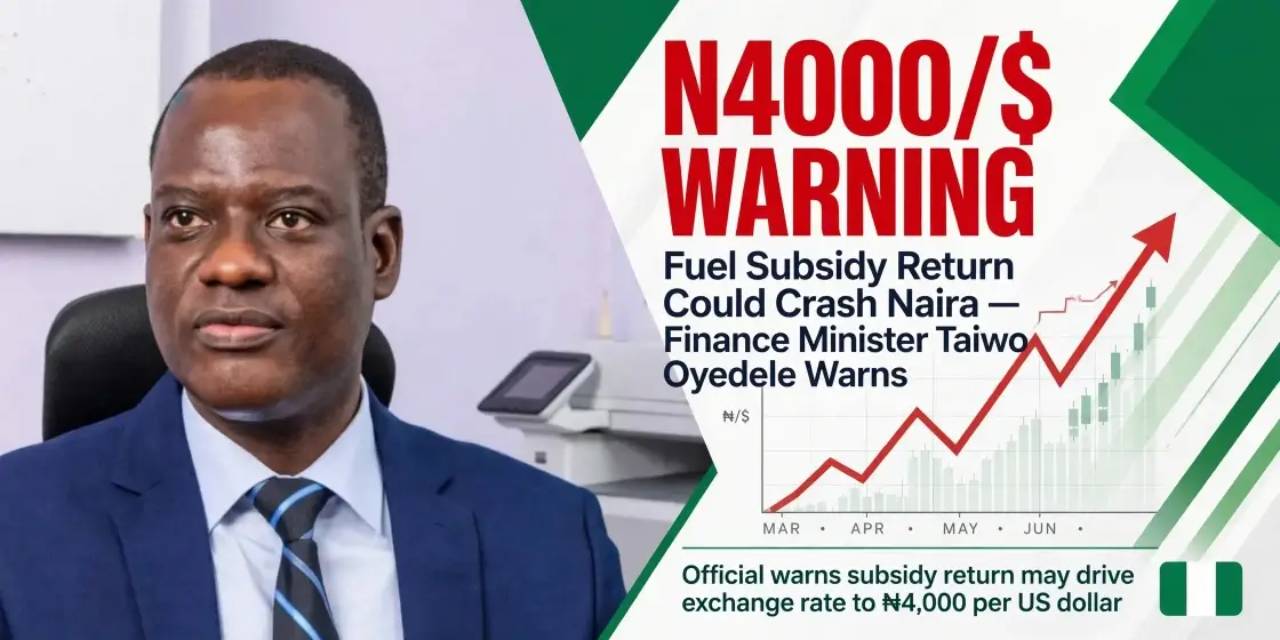
The Minister of Finance and Coordinating Minister of the Economy, Taiwo Oyedele, has warned that any attempt to bring back fuel subsidy could trigger massive capital flight and push the Naira to as high as N4,000 per dollar.
Oyedele issued the warning at the closing press briefing of the 2026 International Monetary Fund and World Bank Annual Meetings in Bangkok, Thailand, on Monday, where he spoke alongside CBN Governor Olayemi Cardoso and Minister of Budget Atiku Bagudu.
What Oyedele Said in Bangkok
According to the Finance Minister, investors both locally and internationally have repeatedly questioned whether President Bola Tinubu's administration would abandon its economic reforms ahead of the 2027 general elections. He noted that the domestic and international markets have largely written off opposition calls for subsidy return, pricing in policy continuity and a second term for Tinubu.
Oyedele, who assumed office as Finance Minister on April 23, 2026, after taking over from former Minister Wale Edun, firmly ruled out any reversal of the current reforms. He stressed that even a mere signal that the government was considering subsidy return would have immediate and severe consequences on the financial markets.
“In all the meetings I have had, I came to a conclusion that the markets, including the domestic market, which you can read from the capital market, and the international market, have largely written off the opposition in Nigeria as being unserious. If, for any reason, the President were to say we are merely considering the return of fuel subsidy, capital would react immediately. Airfares would struggle, the naira would come under severe pressure, potentially moving towards 3,000, 3,500 or even 4,000. The very fuel people want subsidised would become far more expensive in naira terms.â€
Explaining further, Oyedele said the warning was not just about foreign investors pulling out funds. He noted that wealthy Nigerians, business owners, and middle-class investors would also rush to convert their Naira holdings to dollars as a safe haven, thereby increasing demand for foreign exchange and putting further pressure on the local currency.
Why Naira Could Crash to N4,000 Per Dollar
The Finance Minister explained that restoring subsidy would send a negative signal about the Federal Government's commitment to fiscal discipline and economic restructuring. This would erode investor confidence built since the removal of fuel subsidy in May 2023 and undermine recent gains in the foreign exchange market, where the Naira currently trades around N1,450 to N1,550 per dollar.
Oyedele warned that the consequences would go beyond the forex market. He said capital flight would lead to higher borrowing costs for both government and businesses, reduced foreign direct investment, and increased import costs. He cited Indonesia's recent experience where the Jakarta Composite Index fell by 11.6% in one day after MSCI raised concerns about market accessibility, as an example of how quickly markets react to policy uncertainty.
What This Means for Ordinary Nigerians
According to Oyedele, ordinary Nigerians would ultimately bear the brunt if subsidy is reintroduced. He argued that while the intention may be to make fuel cheaper, the resultant crash of the Naira would make fuel even more expensive in Naira terms, as Nigeria still imports a significant portion of refined petroleum products priced in dollars.
He also disclosed that the Federal Government had recently implemented a temporary 30-day petrol discount at NNPC retail stations by forgoing its retail profit margin, and is negotiating a ceiling of N1,350 per litre on ex-gantry or landing cost, subject to monthly reviews. He described these as targeted, temporary relief measures and not a return to blanket subsidy, in line with IMF advice that support should be limited, targeted and temporary.
The minister further highlighted that the Federal Government's cash transfer programme has reached over 10 million households, while over 1.5 million students have benefited from education support initiatives, as part of measures to cushion the effects of reforms on vulnerable citizens.
M2NICE Editorial Note: The warning comes as fuel currently sells between N800 and N900 per litre and political debates ahead of 2027 intensify. While opposition figures have called for subsidy return to ease hardship, economists note that Naira stability at N1,500/$ is directly tied to subsidy removal and FX liberalisation. Any reversal without crude refining capacity at full scale could trigger the capital flight Oyedele described.