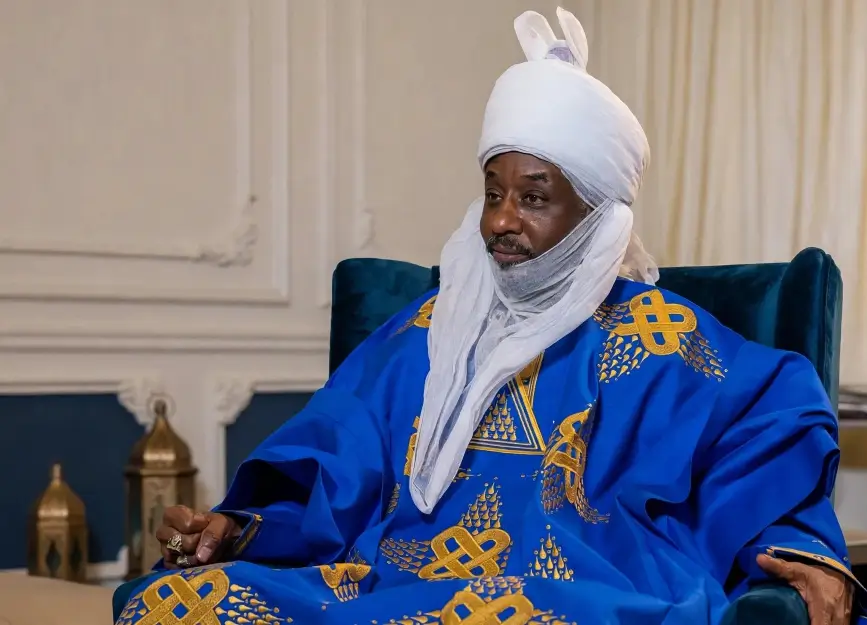
Emir of Kano, Muhammadu Sanusi II, has raised a fresh alarm over Nigeria’s worsening debt profile, warning that the country’s rising debt burden and wasteful government spending are threatening its long-term economic sustainability.
The former Central Bank of Nigeria (CBN) Governor made the warning while speaking virtually on Tuesday at the Oxford Global Think Tank Leadership Conference held in Abuja, where he called on the Federal Government to urgently embrace fiscal discipline and reprioritise its spending.
124% of Revenue Spent on Debt Servicing – Sanusi Cites World Bank
Sanusi, who is one of Nigeria’s most vocal economists, cited World Bank figures showing that Nigeria spent 124 per cent of its Federal Government revenue on debt servicing in the first half of 2026 alone. He described the figure as unsustainable and a clear sign of economic distress.
According to him, Nigeria cannot achieve fiscal consolidation while continuing to spend without restraint. He stressed that the current trajectory, if not checked, will leave little room for investment in critical sectors that drive growth and development.
“That is not how to respond to economic distress,” Sanusi said, while reacting to the huge debt service-to-revenue ratio, urging the government to make tough but necessary choices on spending.
The Emir explained that every $10 billion spent on one sector, such as roads, is $10 billion taken away from other critical areas like electricity, agriculture and technology. He therefore urged the government to clearly define its priorities based on available resources rather than trying to do everything at once.
Sanusi Urges Tinubu Government to Listen to Critics
Speaking at the same conference, Sanusi also advised the administration of President Bola Ahmed Tinubu not to view every criticism about poverty and hardship as an attack on the President. He was joined at the conference by renowned businessman Atedo Peterside.
He said constructive criticism should be seen as part of democratic governance and a tool for improving policy. According to him, Nigerians talking about poverty and economic difficulty are not necessarily enemies of the government, but citizens expressing genuine hardship.
Sanusi further acknowledged that some of the current reforms have shown positive signs. He noted that GDP growth has improved from an average of 0.9 per cent under the previous administration to about 4.5 per cent, while inflation has dropped from over 30 per cent to around 14.5 per cent, with foreign reserves also improving.
Need for Structural Reforms Beyond Subsidy Removal
The former CBN chief argued that true economic reform must go beyond fuel subsidy removal and exchange rate liberalisation. He called for a comprehensive reform package that includes stronger institutions, increased private sector investment, and deliberate investment in productive sectors.
He listed electricity, agriculture, rural roads and technology as sectors that should be given top priority if Nigeria wants to achieve sustainable and inclusive growth. Sanusi warned that without these structural reforms, the gains from current policies may not be sustainable.
M2NICE Editorial Note: Nigeria’s debt service has consistently exceeded 100% of revenue in recent years according to World Bank and Debt Management Office data. Sanusi’s warning comes at a time when FG is pushing for more borrowing to fund the 2026 budget, making fiscal discipline a key debate ahead of 2027.